Kamal Aljafari: Disrupted Narratives
Kamal Aljafari’s films can be streamed on DAFilms.
Kamal Aljafari is a filmmaker who refuses to conform to the status quo or accept the prevailing representations imposed on Palestinians. Instead, he reclaims, edits, and transforms the cinematic record to make it his own. His work often reflects a spirit of defiance that echoes his early life. Aljafari was born in Ramle, about a 30-minute drive from Jaffa, one of the oldest urban centers of historic Palestine, much of which has been destroyed by Israel since 1948. His youth was marked by resistance: as a teenager, he was arrested for protesting during the First Intifada and held for six months. This experience, which resurfaces in his work, finds a parallel in his treatment of images as sites of reclamation.
Jaffa is the gravitational center of Aljafari’s filmography. He returns to it over and over again, revisiting the same streets—sometimes within a single film, sometimes across several—with each return adding another layer. He begins close to home, as in The Roof (2006), filming his own family, his childhood home, and the surrounding streets. This approach is also seen in Balconies (2007) and Port of Memory (2009). Over time, his method shifted from shooting new footage to working almost entirely with existing images. The shift began with Israeli fiction films that used Jaffa as a backdrop after the city had been emptied of most of its Palestinian population, as in Recollection (2015). Aljafari calls this a different kind of occupation—a cinematic one.[1] Much of his practice can be understood as an effort to liberate images from it. He goes on to reclaim various Palestinian and Israeli archives, as in A Fidai Film (2024), altering them to tell a different story, one that had not always been visible. By repurposing Israeli fiction films, military propaganda, and confiscated archives, he liberates this footage from Israeli control and uses it to tell the Palestinian narrative.
Aljafari isn’t drawn to the spectacle. He lingers instead on the least visible aspects of Palestinian life, finding in them the quieter anxieties and absurdities of existing within a hostile environment. The pace of most of his films seems to reflect Palestinian steadfastness: unhurried, often still, and patient in the face of everyday erosion and absurdity of occupation. Although his formally rigorous works are not necessarily intended for mass audiences and circulate primarily on the festival circuit, he remains committed to accessibility. In recent years, he has allowed his films to be shown at community and Palestine solidarity screenings around the world, including those organized by our own Kino Palestine collective in Prague and Bratislava. Today, the online platform DAFilms makes his work available through a retrospective of his filmography.
Daily life disrupted
“A lone walker is both present and detached, more than an audience but less than a participant. Walking assuages or legitimizes this alienation.” (Wanderlust: A History of Walking by Rebecca Solnit)
An old man walks in the sun, and as he walks he compulsively leans on every car he passes. Another man is in a hurry, yet he is trapped in a loop. The third man is hazy. He walks expressionlessly against a detached background. These three men are characters in Aljafari’s films, where daily life reigns. Where no one is a stranger. Their walks are contextualized in different stories, yet each retains a sense of alienation between who they are, what they are doing, and where they are.
False normalcy
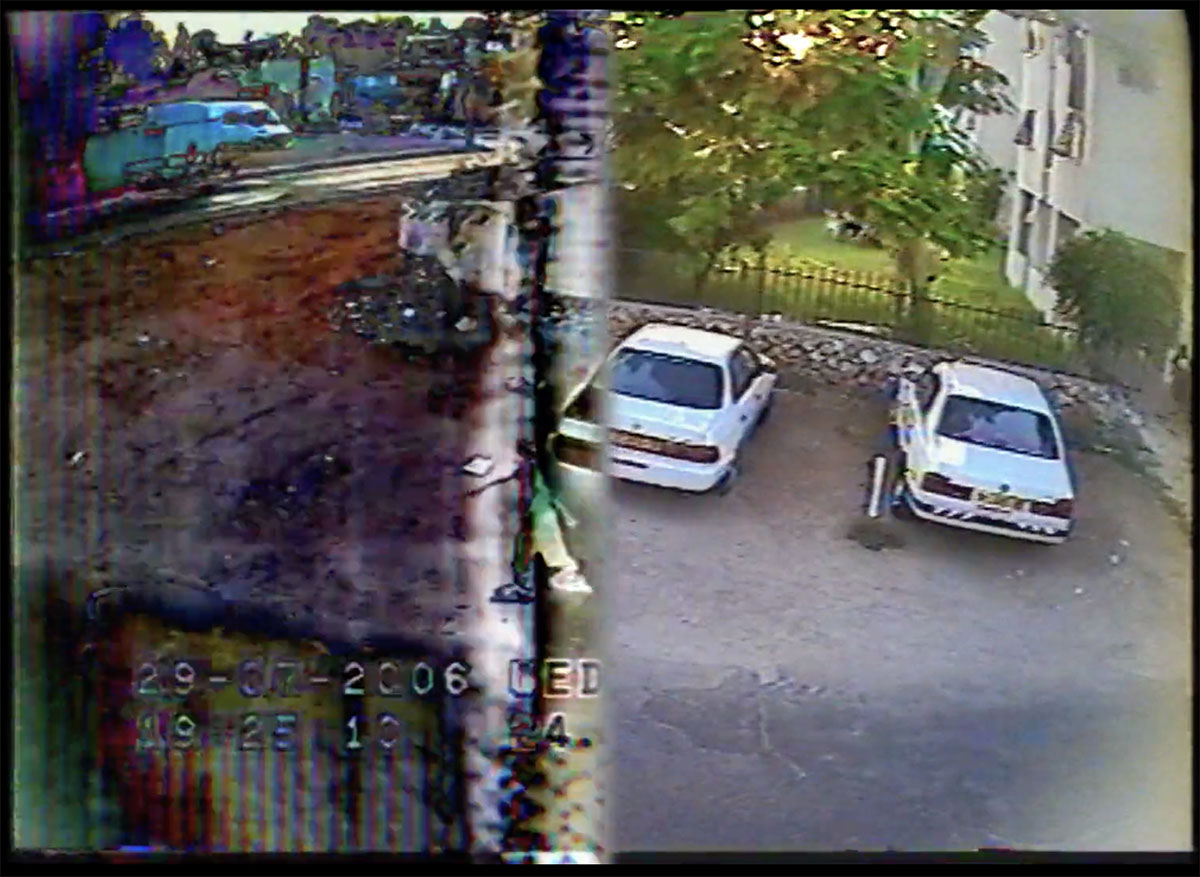
Many of Aljafari’s films draw on images of daily life and its seeming banality. Yet within this daily life there is always an impending false normalcy. An Unusual Summer (2020) operates through a tension of false normalcy where the unsuspecting subjects go about their everyday activities, unaware that they are being filmed by a surveillance camera Aljafari’s father installed to catch the vandal who broke his car window. Aljafari makes his approach to the footage explicit through the intertitle “life must be disrupted in order to be revealed” pointing to the film’s editing style. Disrupting the long takes of the security camera, interjecting them with intertitles, some of which reveal the subjects’ identities.
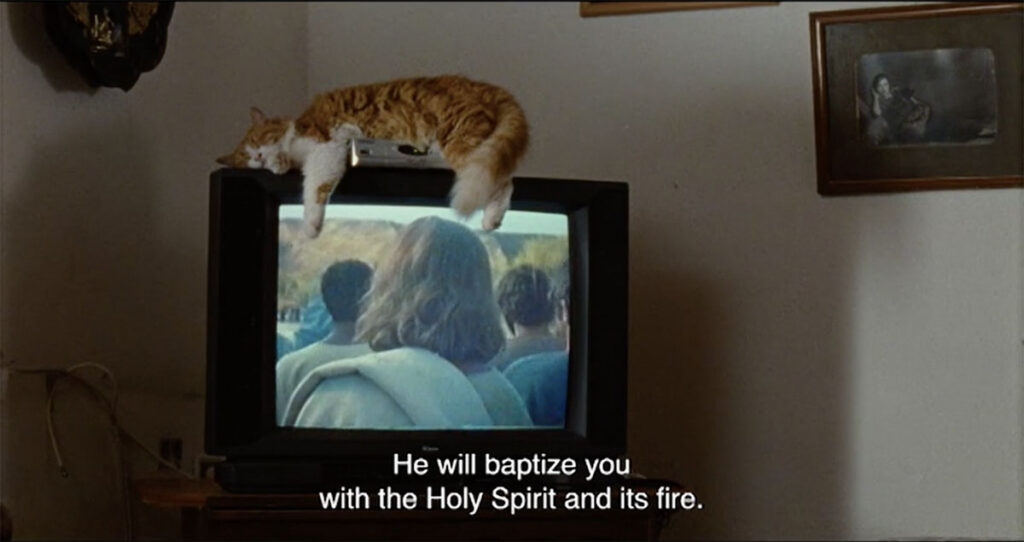
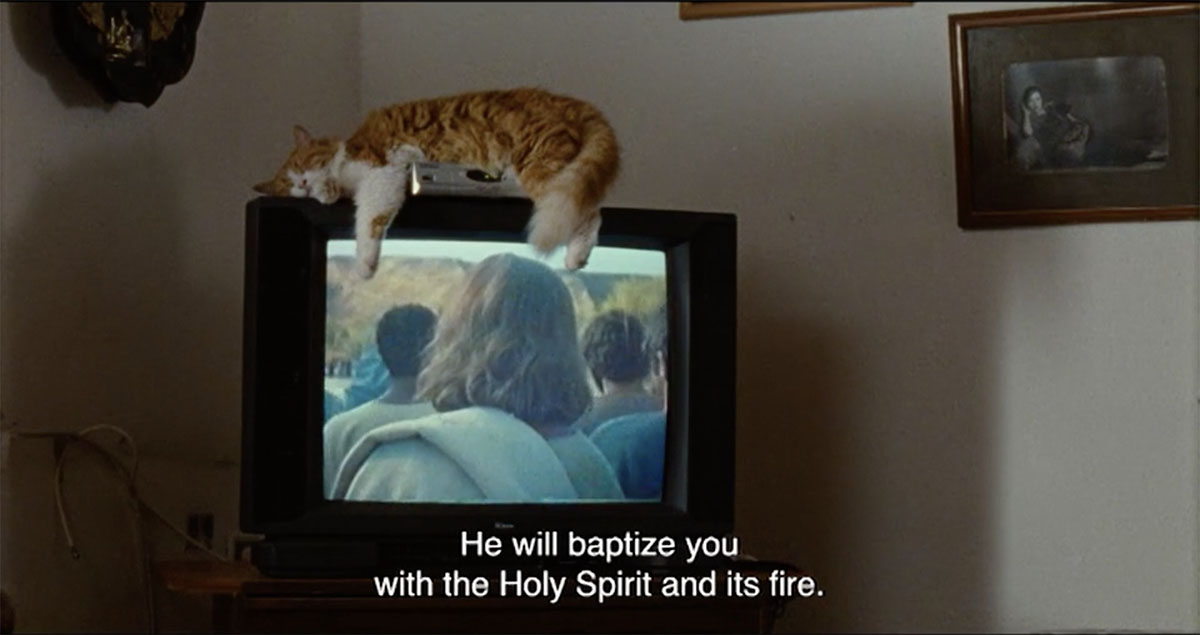
In Port of Memory, much of daily life happens in front of television sets: the familiar, universal image of a couch, a TV, and someone lying in front of it, fighting sleep. In one scene, a TV with a sleeping cat on top broadcasts Jesus (dir. Peter Sykes, John Krish, 1979) dubbed in Arabic. Yet once again, this normalcy is disrupted by the occupation, which manifests itself both in the background and in the foreground. When an Israeli film crew occupies the family’s home to document its historical architecture. When a stranger knocks on their door, asks in Hebrew, “Is this house for sale?” and insists that she wants to buy it. The slightly humorous tone of these sequences also underscores the falseness of this normalcy.
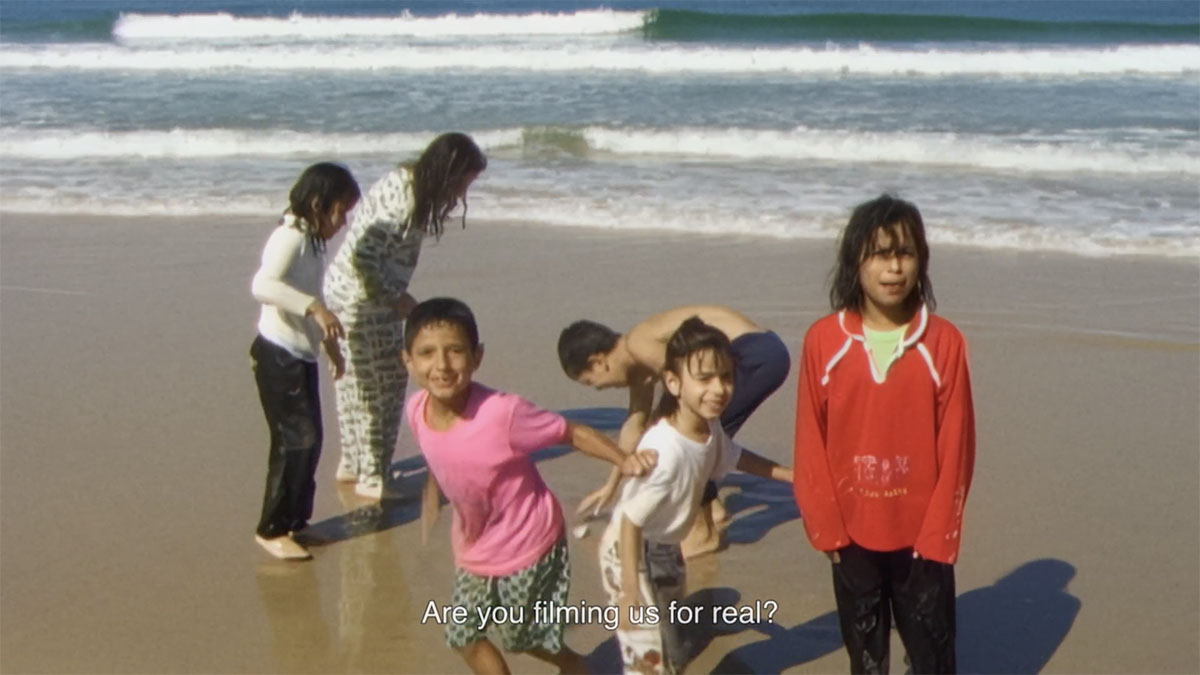
Moreover, With Hasan in Gaza (2025) is the slice-of-life film par excellence. Shot in 2001, this nearly two-hour observational film about everyday life in Gaza consists of rough footage that Aljafari claims he did not edit. The film tackles Plastinians’ desire and need to be photographed and documented. When Gazans notice Aljafari’s camera, they are immediately drawn to him, asking to be filmed, from children catching a fish in the sea to adults playing cards. The false normalcy here lies in the dissonance between seemingly banal everyday life and what is happening in Gaza today. Most of the film is shot from a taxi, and the names of neighborhoods sound familiar to viewers because of a familiarity that comes from recent news reports about their destruction. When images of shops that “are closed for mourning” appear on screen, viewers cannot help but think of present-day Gaza and mourn.

By showing how life persists in the shadow of destruction and occupation, Aljafari emphasizes the disconnect between the familiar environment of daily life and the reality of the violence surrounding them. This false normalcy becomes an ironic act of resistance, refusing to let the spectacle of occupation dominate the entire narrative of the Palestinians living there.
Aljafari’s montage-at-a-distance
In An Unusual Summer, one intertitle which reads “nothing happened”, punctuates the half of the film, as viewers, alongside the director, search in vain for the person who vandalized the car. This nothing is contrasted with the repeated appearance of familiar characters, as viewers learn to trust the narrator’s gaze and gradually build a portrait of the neighborhood alongside him. They come to understand that the film is no longer about finding the culprit but about portraying the neighborhood through its inhabitants and through their daily actions. As the same people reappear, viewers begin to recognize George Soussou in a blue shirt; the inseparable Imses sisters; and even the neighborhood cat. This editing style parallels Artavazd Peleshian’s theory of montage-at-a-distance, in which a film’s structure does not follow a conventional montage chain but instead takes on a circular form. The “bearing shots” (repeated shots) maintain a bidirectional connection with other segments of the film. In doing so, they initiate a chain reaction, linking what the viewer has seen before to what will appear afterward.[2]
In other words, two identical shots repeated at different points in a film could build new meanings depending on the moment they reappear. Although the bearing shots in An Unusual Summer are not identical, they carry a similar charge to the one Peleshian describes. Through meticulous, rhythmic repetition and by lingering on seemingly trivial details, such as the path of a plastic bag or the repeated gait of a walker, Aljafari creates a cinematic space in which these lives gain a right to exist. For example, as the man who leans on cars appears again and again, his significance changes from that of a passerby to a suspect, and, ultimately, to a thread in the larger portrait of the neighborhood. His repeated appearances connect him to the other characters throughout the film, connections that persist even after the screening ends.
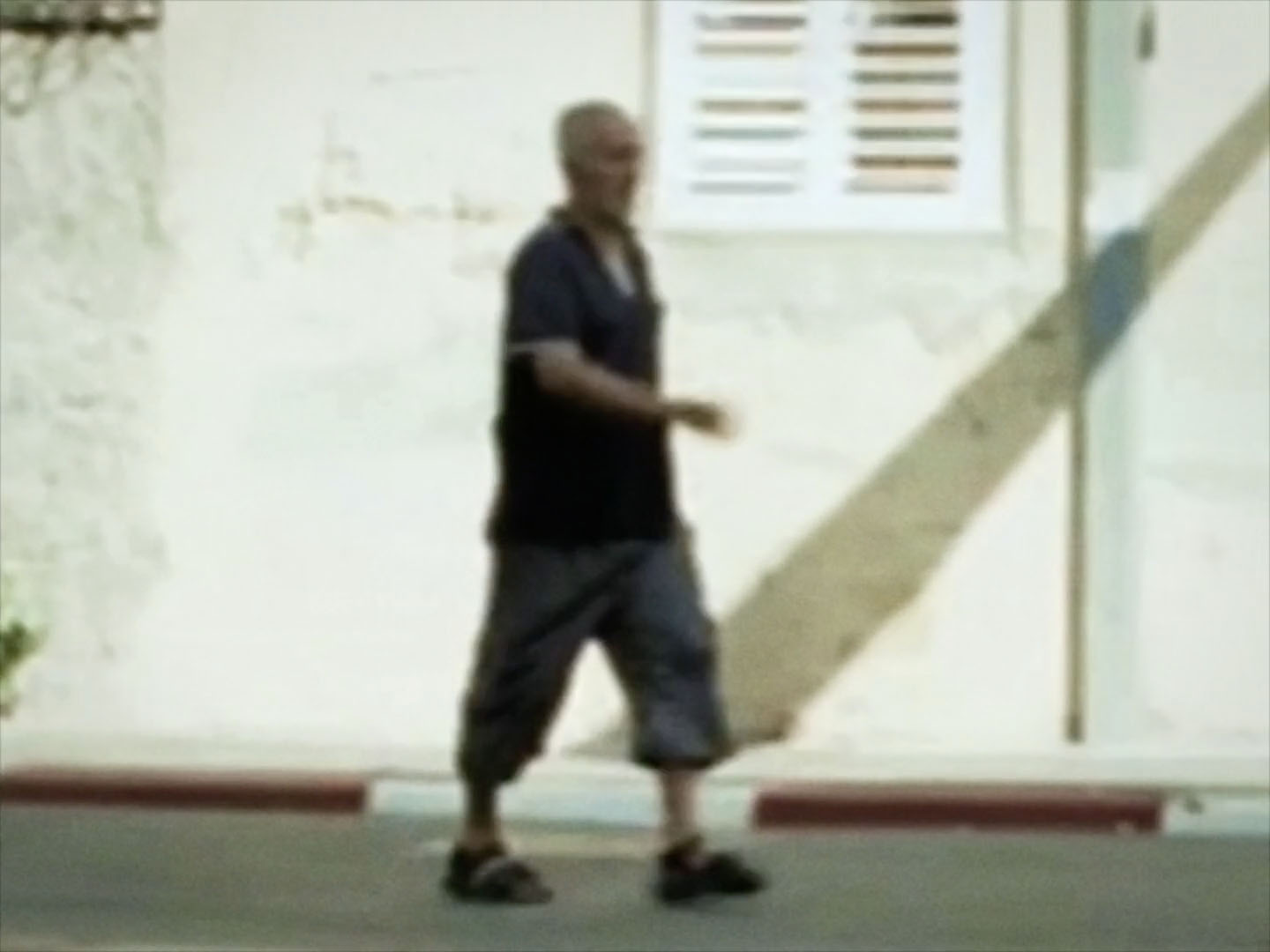
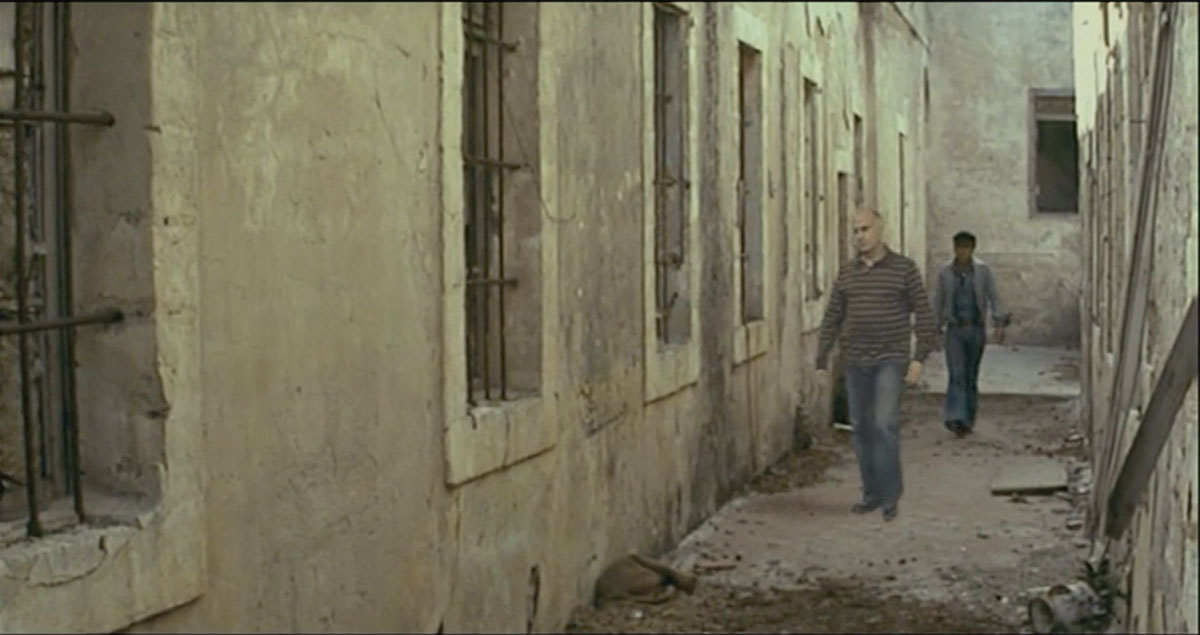
One of Aljafari’s most experimental films, Recollection, is built around the technique of erasing the occupier from the foreground of the footage and highlighting Palestinians in the background by reframing shots and creating loops. While Peleshian used loops hidden in plain sight to extend the duration of several shots, Aljafari draws attention to his loops in a self-reflective way. The loops draw attention to themselves. One example is a man who walks hurriedly from the left of the frame to the right. By looping this action and repeating it several times throughout the film, the viewers are forced to be drawn to and focus on the man’s face. Only for it to be revealed in the end credits that this is “Uncle Mahmoud, who every Sunday is on his way back to the hospital.” The film’s original title, استعادة, carries a more nuanced meaning than Recollection. It does not explicitly invoke memory; instead, it emphasizes the act of taking back what is yours. And that is precisely what the film does.
Inclusion and exclusion
What is particularly unique about Recollection is that Aljafari does not treat the people on whom he focuses his gaze as strangers. He declares that “every rock has a name.” Consequently, the people are not random, rather Aljafari anchors them in a past daily life and catapults them into the present through details that are sometimes seemingly factual and at other times speculative. The credits range from accurate anecdotes such as “this woman stopped speaking to her sister after she got married” to conjectures about what might have been. In doing so, he removes the sense of alienation from their walks and incorporates these figures into his personal history—as in “the girl with the schoolbag could have been my mother.”
Similarly to An Unusual Summer, Aljafari starts with the personal—from footage recorded by his father to scenes of his mother regularly driving his sister to work. He begins with family members before expanding his research to others. Through Aljafari’s filmography, this personal level acts as the catalyst for reclaiming his country. In his films, he reclaims his city, Jaffa, as well as his country. One particularly important sequence in Port of Memory can be considered as inverted Recollection. In this sequence, Aljafari stitches Salim Bilbesi, one of the subjects of the film, ontop of film footage of Kazablan (dir. Menahem Golan, 1973),[3] he digitally removes the Israeli protagonist of the film, and includes his Palestinian protagonist to the forefront. Yet, due to the quality of the image, the alienation of Bilbesi is heightened.
Another recurring piece of footage in Aljafari’s films comes from the Chuck Norris film The Delta Force (dir. Menahem Golan, 1986). It first appears in Port of Memory, where we see someone watching the film on television. In Recollection, however, Aljafari actively manipulates the footage, removing Chuck Norris along with all the other actors. This exclusion of the occupier and inclusion of the occupied are also central in With Hasan in Gaza. By presenting it as a found film with only minor trims here and there. Aljafari raises what Ramtin Teymouri describes as “the question of time and temporal experiences when reflecting on the past and how it is understood, depicting the experience of the present moment, and anticipating the future speculatively.”[4] His films are therefore concerned not only with the past but also with the present and an uncertain future.
Aesthetic counter-narrative
“I work with abstractions, which kind of help to express myself in a way that is detached from the people that you see but the ideas that they represent.”[5]
Aljafari’s work places equal importance on experimentation with form, as he does to the content of the images he uses. He does not shy away from digitally manipulating the images or archival material he uses. However, his early documentaries, such as Visit Iraq (2003) and The Roof, do not yet exhibit the visual language for which he would later become known. They rely on a stationary camera, slow pans, patient observation of family, neighborhood, and immediate surroundings. Aljafari sometimes appears in the frame himself. The concerns that would occupy him for the next two decades are already present—the hidden presence of “the other,” as in the case of an Iraqi Airways office in Geneva, or the chronicles of the house in Ramle where his family still lives. Yet his method remains essentially documentary: he relies on footage he has recorded himself and presents it from his own vantage point.
The shift comes when he puts the camera down. Aljafari views existing footage as a fertile source of new meaning, an approach he partly attributes to the isolation of the pandemic years.[6] Archival and found footage move to the center of his work, but not as evidence or absolute truth. Aljafari does not trust these images to tell the story on their own, as the story itself has been hijacked. For much of the past century, as Palestinian images were seized or destroyed, their right to narrate was denied. What he practices instead is a kind of sabotage or hijacking: he marks the image, writes across it, colors it, crops it, and reframes it. He has called this “a sabotage that is also a reconstruction, reclaiming from the footage latent narratives, creating a counter-archive from repurposed images, and making Israeli fiction more fictional, so that another reality can be revealed.”[7] The aim is not repair. For Aljafari, the existing archive of Palestine is already a stream of stolen and disfigured images. His interventions disfigure them again, but this time deliberately, overtly, and on his own terms.
Sabotaging in red
Aljafari’s archival practice has evolved into a focused effort to reclaim Palestinian imagery once seized by Israel. This is evident in his most widely circulated film, A Fidai Film. In 1982, during the Israeli invasion of Beirut, Israeli forces seized the archive of the Palestine Research Center, the largest archive Palestinians had assembled up to that point, which included the film and photographic archive of the Palestine Film Unit. Much of the material disappeared into Israeli institutions, becoming effectively inaccessible to the people who had created it and those it depicted. A Fidai Film draws on fragments of this material and can be understood as an act of reclamation: an archive taken by force and reclaimed by the people from whom it was seized.

Throughout the archival footage, Aljafari floods the images with red. Scribbles, animated marks, and intertitles carry the narrative when picture or sound cannot. He covers in red the text that the Israeli Archives added to Palestinian images, which usually describes Palestinians as terrorists. He also covers the hands, bodies, and faces of Israeli settlers and actors appearing in a fiction film shot in Jaffa, removing them from the landscape, while ensuring that traces of their removal remain visible. He covers the burning sun in red before setting the entire city on fire through visual effects at the end of the film. “The colour red represents everything I felt during the work I did on this film,” he has said. “It was all red.” He associates the color with the fires that recur throughout the footage, many of them set by the Israeli army, and to blood—“the blood of the Palestinian people that is being shed all the time.”[8] The choice also has an almost incidental origin: while working with footage so degraded that white gaps ran across the frame, he began filling those gaps with red. In this way, damage does not remain merely damage. It becomes a visual tool, a wound rendered visible rather than smoothed over.
Red also appears in It’s a Long Way from Amphioxus (2019), which shares its title with a 1921 song later performed by American singer and biologist Sam Hinton. The song humorously traces human evolution back to a marine ancestor. In the film, Aljafari depicts a cold, sterile German immigration office where people wait for their turn, watching for their numbers to appear on a screen. Towards the end of the film, the red numbers escape the screens, leave the cold, blue building together, and fly away. Here, the contrast between the red numbers and the cold atmosphere of the office and city suggests a refusal to submit to the bureaucratic, dehumanizing maze created by the German—or, more broadly, European—immigration system.
Reframing occupation
Aljafari uses reframing to similar ends, but at the level of composition and shot sizes. In A Fidai Film and Recollection, subjects relegated to the margins of the original Israeli footage are brought forward and made the focus of the shot. The gesture is literal: Aljafari crops and reframes the image, transforming what was peripheral into something central.
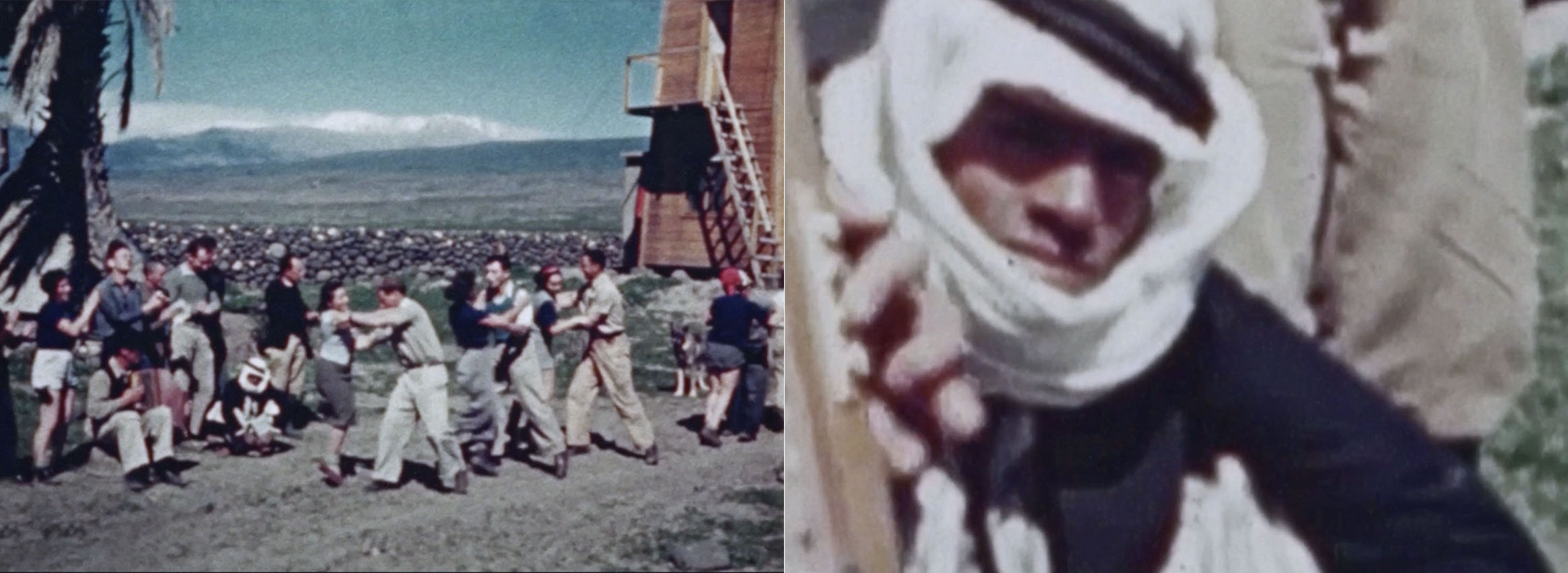
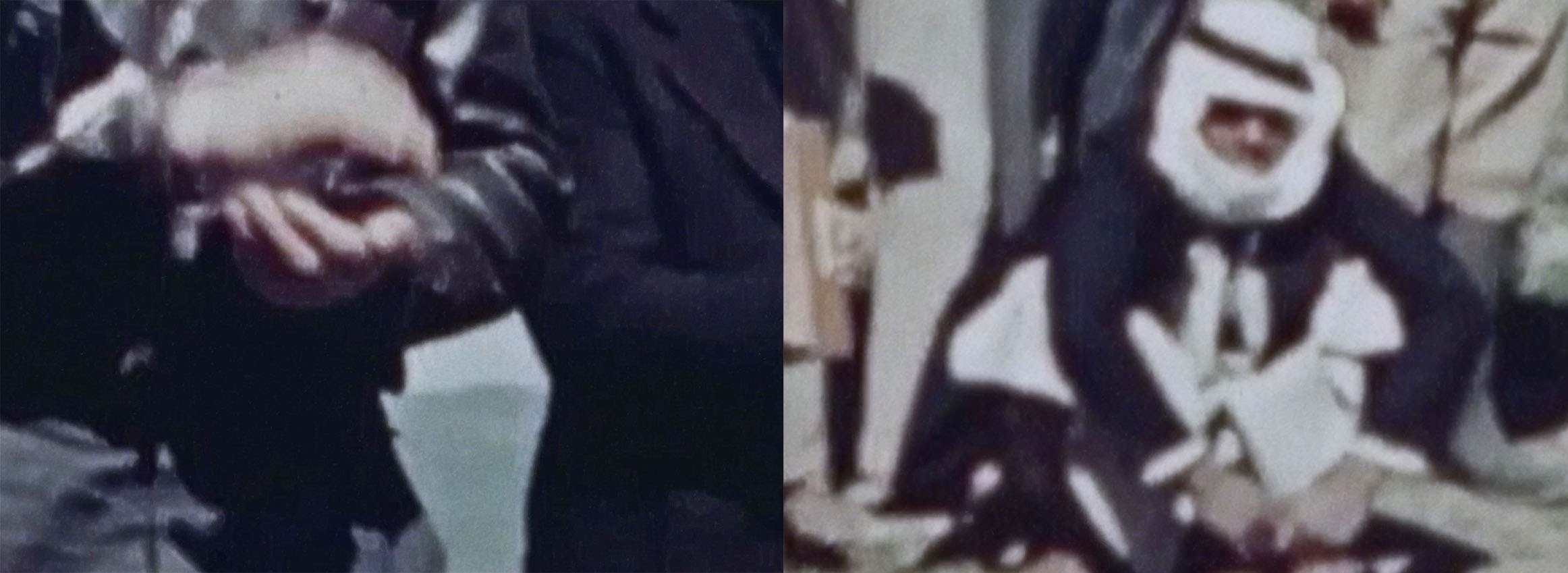
In one scene from A Fidai Film, a group of people, most likely Jewish immigrants, are dancing while a lone Palestinian sits on the floor, initially barely noticeable at the edge of the frame. Aljafari reframes the shot to give the man his close-up. He appears less joyful than the others, who are chanting, smiling, and dancing, and seems detached from their celebration. But Aljafari makes sure that the viewers see him at the moment he looks directly into the camera, as though trying to communicate something. The cropped image tilts upward to show the clapping hands of one of the celebrants before returning to the Palestinian man, his hands lowered, emphasizing the contrast within an otherwise seemingly peaceful and joyful scene.
This sequence unfolds alongside text that appears on screen:
– Do you think they pay attention to us?
– I don’t know. It depends
– But they have to pay attention to us!
– Why do they have to pay attention to us?
– Because after all, we are here
– Where are we?
This reframing, which further degrades the image, seems to slow down a fleeting moment. The man becomes less sharp, as though he were a memory being recalled. In An Unusual Summer, Aljafari uses the same technique, alongside sound, to draw attention to what might otherwise go unnoticed. Here, however, reframing operates within the context of surveillance, isolating particular actions from an ordinary day.
In both cases, the effect is to show viewers precisely what a frame was constructed to leave out or ignore, thereby unsettling the authority of the history that frame served.
Fragmented images
This attention to omission extends to to the physical condition of the footage itself. Much of the material Aljafari works with was never properly preserved. It is degraded, incomplete, sometimes barely legible, and often reached him through unconventional means. He does not conceal its condition, nor does he attempt to restore it simply for the sake of clarity. When he retouches images, he works within the damage rather than against it, filling gaps without pretending they were never there.
This is also apparent in An Usual Summer, in which Aljafari explores another kind of found footage: surveillance recordings. This time, it is not the state conducting surveillance but his father. The filmmaker turns this pixelated footage of ordinary daily life into a humanistic record of his neighborhood’s existence. The surveillance-camera aesthetic operates in two ways: on the one hand, it evokes a broader condition of surveillance, particularly for Palestinians living under Israeli rule; on the other, it chronicles the slow passage of time encapsulated in these pixelated images. At one point in the film, a boy on skates moves from a clear image into visibly corrupted footage. For a moment, the material itself becomes visible as material, and the film acknowledges that we are watching images that have survived time and digital erosion.
Another variation appears in With Hasan in Gaza, where the grainy texture evokes familiar, soft pixelation of an early-2000s camcorder. As we watch these seemingly ordinary scenes of Gaza in the early 2000s, that familiarity quietly makes the city seem like a place we might already know, even if we have never been there. The footage also raises a question that runs throughout Aljafari’s use of found and archival material: What is the political value of a home video in the context of Palestine? Despite its low resolution or scratches, the image retains its value as testimony, however fragile, that these streets and these lives existed, despite the ongoing attempts to erase them.
These gaps also become central to the work. “There are lots of missing pieces,” Aljafari has said. “It’s not possible to make a film where you can complete the history. That’s why the film is made in fragments, because I could only collect traces.” The image’s condition bears witness to what it had to survive simply to exist. This is close to what Hito Steyerl has called “the poor image”: an image stripped of resolution, quality, and sometimes even legibility, yet valuable not for how well it was preserved but because it endured—copied, degraded, passed on, and made accessible to others.[9] In the context of Palestinian archives seized and held in colonial institutions, scattered, or left to decay, this is less an aesthetic position than a material fact. A pristine image was rarely an option. The poverty of the image is itself a record of the history that produced it.
Taken together, these methods form not separate techniques but one cohesive, sustained practice. Aljafari works with images that have survived, reclaims those removed from their original contexts, and lingers on the repetition of ordinary life under occupation and erasure. The footage has not always survived intact: it bears the marks of destruction, seizure, or simple neglect. However, Aljafari does not seek to restore the archive. Instead, he disfigures it again on his own terms, and in this second disfigurement, takes back control of the narrative and makes room for another reality to emerge. He questions the status of images as historical evidence. His work resonates with Saidiya Hartman’s argument that “the necessity of trying to represent what we cannot, rather than leading to pessimism or despair, must be embraced as the impossibility that conditions our knowledge of the past and animates our desire for a liberated future.”[10] His filmography lives on through acts of resistance: Palestinians cease to be anonymous, and their right to exist extends to their right of individuality. They are not hollow vessels for the Palestinian cause, nameless figures in the background. Rather, each has a past, a present, and a future. Existing.
Proofreading: Tomáš Eštok
Notes:
[1] ALJAFARI, Kamal. The Credits of my Next Movie. In: FUSE Magazine, Palestine, Spring Issue 2013.
[2] PELECHIAN, Artavazd. Montage-at-a-Distance, or: A Theory of Distance. Translated by Julia Vassileva. In: LOLA, Issue 6, December 2015.
[3] The film portrays a love story all the while completely erasing the indigenous Palestinian history and population of the city.
[4] TEYMOURI, Ramtin. A Temporal Study of Palestinian Cinema (PhD thesis). University of Toronto, Cinema Studies Institute, 2023
[5] NAVAS, Miguel. Kamal Aljafari. Reclaiming Memory. In: Metal Magazine, 28 February 2025.
[6] Rutger Wolfson & Kamal Aljafari. In: 25 Encounters. Rotterdam: Stichting International Film Festival Rotterdam, 2022.
[7] ALJAFARI, Kamal. A Fidai Film. In: Journal of Visual Culture, Volume 20, Issue 2: The JVC Palestine Portfolio (August 2021), p. 347.
[8] NAVAS, Miguel. Kamal Aljafari. Reclaiming Memory. In: Metal Magazine, 28 February 2025.
[9] STEYERL, Hito. In Defense of the Poor Image. In: e-flux Journal, Issue 10 (11/2009), p 86–92.
[10] HARTMAN, Saidiya. Venus in Two Acts. In: Small Axe, Number 26 (Volume 12, Number 2), 2008, p.13.
Pictures:
[1, 2, 5] Port of Memory (dir. Kamal Aljafari)
[3] With Hasan in Gaza (dir. Kamal Aljafari)
[4] Recollection (dir. Kamal Aljafari)
[6 – 11] A Fidai Film (dir. Kamal Aljafari)
[12] An Unusual Summer (dir. Kamal Aljafari)
Kamal Aljafari’s films can be streamed on DAFilms.
Kamal Aljafari is a filmmaker who refuses to conform to the status quo or accept the prevailing representations imposed on Palestinians. Instead, he reclaims, edits, and transforms the cinematic record to make it his own. His work often reflects a spirit of defiance that echoes his early life. Aljafari was born in Ramle, about a 30-minute drive from Jaffa, one of the oldest urban centers of historic Palestine, much of which has been destroyed by Israel since 1948. His youth was marked by resistance: as a teenager, he was arrested for protesting during the First Intifada and held for six months. This experience, which resurfaces in his work, finds a parallel in his treatment of images as sites of reclamation.
Jaffa is the gravitational center of Aljafari’s filmography. He returns to it over and over again, revisiting the same streets—sometimes within a single film, sometimes across several—with each return adding another layer. He begins close to home, as in The Roof (2006), filming his own family, his childhood home, and the surrounding streets. This approach is also seen in Balconies (2007) and Port of Memory (2009). Over time, his method shifted from shooting new footage to working almost entirely with existing images. The shift began with Israeli fiction films that used Jaffa as a backdrop after the city had been emptied of most of its Palestinian population, as in Recollection (2015). Aljafari calls this a different kind of occupation—a cinematic one.[1] Much of his practice can be understood as an effort to liberate images from it. He goes on to reclaim various Palestinian and Israeli archives, as in A Fidai Film (2024), altering them to tell a different story, one that had not always been visible. By repurposing Israeli fiction films, military propaganda, and confiscated archives, he liberates this footage from Israeli control and uses it to tell the Palestinian narrative.
Aljafari isn’t drawn to the spectacle. He lingers instead on the least visible aspects of Palestinian life, finding in them the quieter anxieties and absurdities of existing within a hostile environment. The pace of most of his films seems to reflect Palestinian steadfastness: unhurried, often still, and patient in the face of everyday erosion and absurdity of occupation. Although his formally rigorous works are not necessarily intended for mass audiences and circulate primarily on the festival circuit, he remains committed to accessibility. In recent years, he has allowed his films to be shown at community and Palestine solidarity screenings around the world, including those organized by our own Kino Palestine collective in Prague and Bratislava. Today, the online platform DAFilms makes his work available through a retrospective of his filmography.
Daily life disrupted
“A lone walker is both present and detached, more than an audience but less than a participant. Walking assuages or legitimizes this alienation.” (Wanderlust: A History of Walking by Rebecca Solnit)
An old man walks in the sun, and as he walks he compulsively leans on every car he passes. Another man is in a hurry, yet he is trapped in a loop. The third man is hazy. He walks expressionlessly against a detached background. These three men are characters in Aljafari’s films, where daily life reigns. Where no one is a stranger. Their walks are contextualized in different stories, yet each retains a sense of alienation between who they are, what they are doing, and where they are.
False normalcy
Many of Aljafari’s films draw on images of daily life and its seeming banality. Yet within this daily life there is always an impending false normalcy. An Unusual Summer (2020) operates through a tension of false normalcy where the unsuspecting subjects go about their everyday activities, unaware that they are being filmed by a surveillance camera Aljafari’s father installed to catch the vandal who broke his car window. Aljafari makes his approach to the footage explicit through the intertitle “life must be disrupted in order to be revealed” pointing to the film’s editing style. Disrupting the long takes of the security camera, interjecting them with intertitles, some of which reveal the subjects’ identities.
In Port of Memory, much of daily life happens in front of television sets: the familiar, universal image of a couch, a TV, and someone lying in front of it, fighting sleep. In one scene, a TV with a sleeping cat on top broadcasts Jesus (dir. Peter Sykes, John Krish, 1979) dubbed in Arabic. Yet once again, this normalcy is disrupted by the occupation, which manifests itself both in the background and in the foreground. When an Israeli film crew occupies the family’s home to document its historical architecture. When a stranger knocks on their door, asks in Hebrew, “Is this house for sale?” and insists that she wants to buy it. The slightly humorous tone of these sequences also underscores the falseness of this normalcy.
Moreover, With Hasan in Gaza (2025) is the slice-of-life film par excellence. Shot in 2001, this nearly two-hour observational film about everyday life in Gaza consists of rough footage that Aljafari claims he did not edit. The film tackles Plastinians’ desire and need to be photographed and documented. When Gazans notice Aljafari’s camera, they are immediately drawn to him, asking to be filmed, from children catching a fish in the sea to adults playing cards. The false normalcy here lies in the dissonance between seemingly banal everyday life and what is happening in Gaza today. Most of the film is shot from a taxi, and the names of neighborhoods sound familiar to viewers because of a familiarity that comes from recent news reports about their destruction. When images of shops that “are closed for mourning” appear on screen, viewers cannot help but think of present-day Gaza and mourn.
By showing how life persists in the shadow of destruction and occupation, Aljafari emphasizes the disconnect between the familiar environment of daily life and the reality of the violence surrounding them. This false normalcy becomes an ironic act of resistance, refusing to let the spectacle of occupation dominate the entire narrative of the Palestinians living there.
Aljafari’s montage-at-a-distance
In An Unusual Summer, one intertitle which reads “nothing happened”, punctuates the half of the film, as viewers, alongside the director, search in vain for the person who vandalized the car. This nothing is contrasted with the repeated appearance of familiar characters, as viewers learn to trust the narrator’s gaze and gradually build a portrait of the neighborhood alongside him. They come to understand that the film is no longer about finding the culprit but about portraying the neighborhood through its inhabitants and through their daily actions. As the same people reappear, viewers begin to recognize George Soussou in a blue shirt; the inseparable Imses sisters; and even the neighborhood cat. This editing style parallels Artavazd Peleshian’s theory of montage-at-a-distance, in which a film’s structure does not follow a conventional montage chain but instead takes on a circular form. The “bearing shots” (repeated shots) maintain a bidirectional connection with other segments of the film. In doing so, they initiate a chain reaction, linking what the viewer has seen before to what will appear afterward.[2]
In other words, two identical shots repeated at different points in a film could build new meanings depending on the moment they reappear. Although the bearing shots in An Unusual Summer are not identical, they carry a similar charge to the one Peleshian describes. Through meticulous, rhythmic repetition and by lingering on seemingly trivial details, such as the path of a plastic bag or the repeated gait of a walker, Aljafari creates a cinematic space in which these lives gain a right to exist. For example, as the man who leans on cars appears again and again, his significance changes from that of a passerby to a suspect, and, ultimately, to a thread in the larger portrait of the neighborhood. His repeated appearances connect him to the other characters throughout the film, connections that persist even after the screening ends.
One of Aljafari’s most experimental films, Recollection, is built around the technique of erasing the occupier from the foreground of the footage and highlighting Palestinians in the background by reframing shots and creating loops. While Peleshian used loops hidden in plain sight to extend the duration of several shots, Aljafari draws attention to his loops in a self-reflective way. The loops draw attention to themselves. One example is a man who walks hurriedly from the left of the frame to the right. By looping this action and repeating it several times throughout the film, the viewers are forced to be drawn to and focus on the man’s face. Only for it to be revealed in the end credits that this is “Uncle Mahmoud, who every Sunday is on his way back to the hospital.” The film’s original title, استعادة, carries a more nuanced meaning than Recollection. It does not explicitly invoke memory; instead, it emphasizes the act of taking back what is yours. And that is precisely what the film does.